STAY INFORMED
Register for
Email Updates

Blog

What is Congress waiting for anyway?

While millions of American families struggle to find work, feed their families, or save for retirement, Congressional leaders are once again showing they are out of touch with reality. With an approval rating of 9% — polygamy and the BP’s response to the Gulf oil spill rank higher according to recent polling — it’s difficult to imagine Congress performing any worse.

After the last budget showdown, which actually put the full faith and credit of the United States at risk, Congressional leaders should have learned their lesson. The Christian Science Monitor said that S&P’s downgrade should be a clear signal to Congress to “shape up.” The American people do not want political brinkmanship during a time of economic crisis. Working families are hurting and we are looking to Congress to provide some solutions.

Fast forward to the latest crisis. Millions of unemployed Americans and middle class families are facing a lump of coal in their stockings if Congress does not act soon to extend the payroll tax cut and UI benefits. I mean after all we are talking about tax cuts here so most Americans assumed this deal would get done. We were sort of right.

With a deal seemingly in place, Senators left for a holiday break — and boy do they need it after working so hard this year (sarcasm intended) — convinced they had won a compromise. In their minds, the House would approve the measure, thus rescuing middle class families from a $1,000 tax hike and protecting the unemployed. They were wrong. House Republicans, lead by Tea Partiers, did not want to go along with the compromise. Apparently tax cuts are only for wealthiest Americans, not everyone else.

Now we must sit back and watch Congress once again fumble around and potentially jeopardize our fragile economic recovery.

Members of Congress — what happened to doing what is right for the country?

Did you like this? Share it:

Good Jobs Better Baltimore at “Take Back the Capitol”

Good Jobs Better Baltimore was down in Washington, DC last week to support job creation and to pressure Congressional members into action around key issues that will move our economy forward.

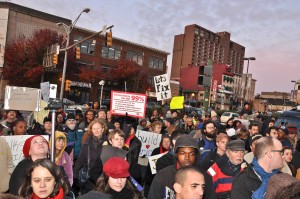
The people’s camp on the National Mall was our home base for action. Despite a driving rain on two of the days — which turned the camp into a muddy mess — members of the 99% were in good spirits.

During out time in DC, we marched up to Capitol Hill, participated in an interfaith vigil, sat in Congressional offices, and rallied on K St. to show lobbyists we need to hold them accountable.

Each day had its own events and opportunities for people to speak their minds to members of the 1%. On Tuesday, we flooded numerous offices on Capitol Hill. Congressional leaders were surprised to see so many people demanding action on job creation and unemployment benefits. Activists expressed their frustration at a government that caters to special interests. People need a break, not corporations.

On Wednesday, activists marched from the camp up 14th street to K street — the seat of lobbying power in Washington, DC. Snaking its way through the streets, marchers stopped at Wells Fargo and Verizon locations to voice displeasure at their policies. Activists then blocked K St and arrests were made. The national media covered the march in story after story, as the 99% made a bold statement — we will not rest until we loosen the dominance of special interests on our government.

On Thursday, activists marched to Capitol Hill to visit Rep. John Boehner, the Speaker of the House. He would not meet with us on this day. After being asked to leave Longworth House Office Building by the Capitol Police, we moved outside to chant and hear stories in an attempt to get his attention. Staffers peered out windows to see what was going on.

After an exciting week of action, people from all over the country are heading back to their states to spread the word that the fight is not over, we need to keep the pressure up. We need to create more jobs and protect the middle class. This will not be achieved by cutting benefits and increasing tax cuts for the rich. It’s time for the 99% to get a break.

To see more pictures and video, please visit our Facebook page.

Did you like this? Share it:

Just say no to the Constellation – Exelon merger

On December 1, 2011, the PSC is holding its final public hearing on the merger in Baltimore city…will you be there?

As part of the final push we are asking supporters to do two things:

(1) Sign a petition saying – I oppose any merger deal that doesn’t include strong job protections, rock solid guarantees for job creation, and real relief from our high bills, now and in the future.

(2) RSVP to the public hearing on Thursday, December 1, 2011 at 101 N. Gay Street. We need to pack the house and let the PSC know we mean business.

Continue Reading

Did you like this? Share it:

Hundreds rally for jobs at the Howard Street Bridge as part of a national day of action

As part of a national day of action on November 17th, activists from Good Jobs Better Baltimore along with MoveOn.org, Occupy Baltimore, BRIDGE (Baltimore Regional Initiative Developing Genuine Equality), Transform Baltimore, 1199SEIU, and 32BJ SEIU marched on the Howard Street Bridge in support of jobs and infrastructure improvements.

Joining similar events in 30+ cities around the country, members of the community marched on the bridge in a peaceful display of solidarity. The catalyst for this event is lack of job growth in Baltimore City and the inability of our leaders to make principled decisions. As our infrastructure crumbles around us, it’s important that local and national leaders focus on putting people back to work fixing our bridges, roads, and schools.

Beginning with speeches in front of Joe Squared Pizza on the North Ave. side of the bridge, we came out because we are tired of the status quo. Many people were moved by the diversity of the crowd and agreed that it was one of the biggest gatherings of its kind in Baltimore in a long time.

The culmination of the march was the unfurling of a banner, which read “Bridge the Gap: Jobs Not Cuts,” high above Interstate 83. As TV helicopters swirled overhead, activists chanted, waved signs, played music, and interacted with commuters who often beeped in support.

This event is just the latest in a series organized by Good Jobs Better Baltimore. Next up: a public hearing on the potential Constellation/Exelon merger on December 1st.

Did you like this? Share it:

As schools and bridges crumble around us, it’s time to wake up and invest in our future

We can no longer kick the can to the next generation. After years of neglect, roads, bridges, ports, and schools are in need of repair.
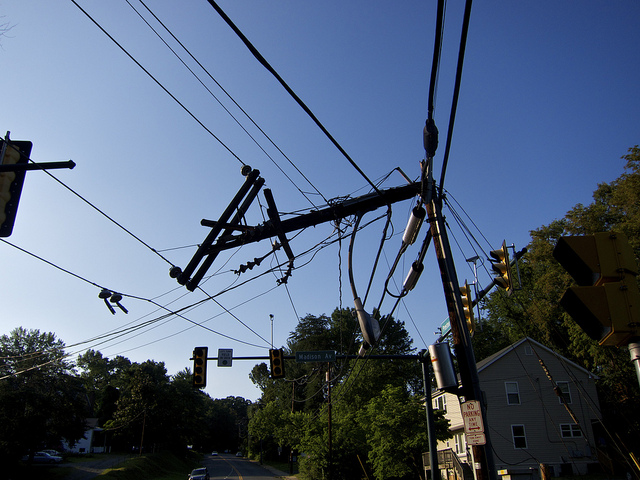
The stories are all around us. Students unable to drink from water fountains for fear of lead poisoning; commuters growing concerned about the 18,000 well-traveled bridges in need of maintenance. Enough is enough. We need to spend money to improve our infrastructure and the time is now.

Recently, the Senate failed to pass legislation that could put people back to work while rebuilding our infrastructure. This is unfortunate because Maryland and Baltimore City could certainly benefit from its passage. According to a report released by Transportation for America, the Baltimore-Towson metro area, as of 2009, has 167 deficient bridges. Over 3 million people cross these bridges every day or about 35 drivers per second.

The failure of the Rebuild America Jobs Act is the latest in a series of defeats for Obama’s jobs legislation. It seems the Republicans in Congress are more concerned with defeating President Obama than investing in our infrastructure or creating new jobs we desperately need. An opinion expressed by a Republican no less.

It’s too bad because the American Jobs Act could have helped states, like Maryland, by providing…

  • $50 billion in immediate investments for highways, transit, rail and aviation, helping to modernize an infrastructure that now receives a grade of “D” from the American Society of Civil Engineers and putting hundreds of thousands of construction workers back on the job.
  • $35 billion to prevent layoffs of up to 280,000 teachers.
  • $25 billion investment in school infrastructure that will modernize at least 35,000 public schools. Maryland will receive $315,800,000 in funding to support as many as 4,100 jobs.
Did you like this? Share it:

Protesters deliver giant petition-filled gourd to Constellation HQ in Baltimore

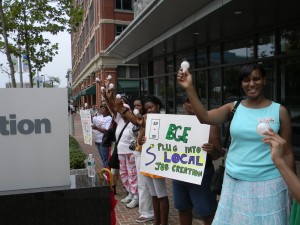
Over 100 activists from the community and Good Jobs Better Baltimore rallied in front of Constellation headquarters to deliver a giant pumpkin, filled with petitions, to CEO Mayo Shattuck.

The activists — angered by the proposed merger deal between BGE parent company, Constellation Energy, and Exelon Corporation — are seeking job protections and guarantees for rate relief. While security would not allow the giant pumpkin to enter the building, the protesters sent a powerful message to energy executives inside — we are not going away; we will fight for a better energy future for Baltimore.

This event comes at an important time in the merger process. The Public Service Commission formally begins it review next week.  CEO Mayo Shattuck and Exelon president Chris Crane are expected testify about the benefits of the merger. They will have to convince a skeptical public, local political leaders, and even their own stakeholders.

To read more about the merger, reason for opposition, and our $810 million proposal, please visit our issue page.

Did you like this? Share it:

Want to complain about BGE’s performance after Hurricane Irene?

Hurricane Irene delivered a glancing blow to the region; yet, 756,000 customers still lost power. On average, BGE customers lost 37 hours of power, more than other utilities’ ratepayers. Was that really BGE’s best effort?
To add insult to injury, now BGE expects to stick customers with part of an estimated $90 million bill for hurricane clean up.

Thankfully, Maryland’s Public Service Commission is investigating BGE’s performance before and after Hurricane Irene and customers will have a chance to vent their frustrations.

As part of the review process, the Maryland Public Service Commission (PSC) wants to hear from people like you.

Interestingly enough, the same Public Service Commission is currently reviewing the potential Constellation – Exelon merger deal. Does BGE’s performance during Hurricane Irene give us confidence that a merger between parent company, Constellation, and Chicago-based Exelon will benefit customers? We think it doesn’t.

Public Service Commission public hearing:

When: October 11, 2011 @ 7pm

Where: Wohlman Assembly Hall of the War Memorial building at 101 N. Gay St.

Additional information:

Did you like this? Share it:

What’s the point of utility regulation if not to object to a deal like this?

On WYPR’s Midday show, host Dan Rodricks, the Baltimore Sun‘s Jay Hancock, Paula Carmody from the Maryland People’s Council, and a spokesman from Constellation discussed the merits of the potential merger deal between BGE parent company, Constellation Energy, and Exelon. A lively discussion ensued and callers expressed concerns over the deal.

In our opinion, BGE customers deserve better than what they are getting right now. Despite what company representatives may say, the public is deeply skeptical of this merger deal. The extended outages after Hurricane Irene might be the last straw. Customers are tried of unreliable service, high utility rates, and jobs flowing out of our city. We need good jobs now, and this merger deal cannot guarantee things will be any better down the road.

Dan Rodricks, the host of the Midday show, wrote an opinion piece on the responsibility of Maryland’s Public Service commission to be “broadly representative of the public interest.” In his opinion, if the PSC does not reject the merger deal as is, they would be doing a great diservice to people in this state. Read the full article below:

Getting to ‘no’ on Constellation-Exelon

What’s the point of utility regulation if not to object to a deal like this?

By: Dan Rodricks
September 28, 2011

A lot of people apparently believe — and in this epoch of corporate hubris, who can blame them? — that the Constellation-Exelon deal is a done deal. They assume the purchase of the Baltimore-based company that owns our beloved Baltimore Gas & Electric Co. by an energy giant in Chicago for $7.9 billion will probably go through, making the smiling rich guys even richer. The whole thing should give BGE customers the creeps; regulators and public advocates are already saying it’s a bad deal for Maryland consumers. But I suspect that most of you believe this merger happens no matter what.

Hey, it’s OK to be jaded. That’s normal. This fall marks the 10th anniversary of the collapse of Enron, the energy-trading giant, and the loss of thousands of jobs and retirement accounts. We’re also upon the third anniversary of the onset of the worst financial crisis since the Great Depression and former Fed chairman Alan Greenspan’s amazing Ayn-Rand-was-wrong moment in Congress: “Those of us who have looked to the self-interest of lending institutions to protect shareholders’ equity … are in a state of shocked disbelief.”

The last three decades have been marked by deregulation and faith in the free markets, exuberant capitalism, corporate buyouts and mergers, tax cuts for the rich, the elimination of millions of American jobs, the decline of organized labor, the stagnation of middle-class income, obscene corporate profits and executive compensation — topped off by wanton mortgage lending and the housing bubble, and followed by the Great Recession and its long, lousy aftermath. What difference do our pathetic little Ralph Naderesque objections ever make to anything the corporate class does? With few exceptions — and often with the complicity of Congress — the smiling rich guys get their way.

So, you’d be hard-pressed to find anyone in Maryland today who thinks that, in the end, the Public Service Commission will tell Constellation Energy that it cannot sell itself to Exelon because it’s a bad deal for Maryland consumers.

Still, call me a fool, but I’m holding out hope for that scene in “It’s A Wonderful Life” where George Bailey feels something icky on his fingers after a handshake with the sinister Mr. Potter, then stands up and angrily says no to a deal with the devil: “You sit around here and you spin your little webs and you think the whole world revolves around you and your money. Well, it doesn’t, Mr. Potter. In the whole vast configuration of things, I’d say you were nothing but a scurvy little spider!”

Where’s our George Bailey? Who’s going to stand up to the rich men in suits who run these companies, and say, “No deal — it’s not good for us”?

Constellation Energy owns BGE and, if the deal goes through, BGE customers will almost certainly end up paying more for gas and electricity. Anyone who went without power in the wake of Hurricane Irene ought to be concerned about whether a local utility owned by an out-of-state energy giant will be able to reliably deliver service to Maryland’s growing population. Plus, corporate mergers usually mean a loss of jobs, and pardon me for being skeptical about Exelon’s claim that there will be net job growth from the deal.

All of these concerns are being addressed by the Maryland People’s Counsel, the Maryland Energy Administration and some of the staff of the PSC and the O’Malley administration. Even the French are skeptical; Constellation’s second-largest shareholder, Electricité de France, has some issues with the deal.

But all of these challenges appeared to be bargaining chips — efforts to sweeten a deal that is considered a fait accompli.

I say nuts to that. What is this deal about besides making the smiling rich guys richer? Why would we put further distance between the corporate governance of BGE and the utility that 1.2 million Maryland customers count on for power? Why would we essentially sell off control of a public utility for $100 a customer and a relatively mediocre package of incentives from a company that makes billions in profits?

The Maryland legislature created the Public Service Commission in 1910 to be “broadly representative of the public interest” and to regulate utilities. What is the point of the PSC if not to reject Mr. Potter-type propositions like Constellation-Exelon?

Dan Rodricks’ column appears Tuesdays, Thursdays and Sundays. He is the host of Midday on WYPR 88.1 FM. His email is [email protected].

Did you like this? Share it:

Wells Fargo: Not Welcome

This Saturday, September 17th, all Wachovia signs will make the symbolic transformation into Wells Fargo signs. You may ask yourself, why should I care about this, after all, a bank is a just bank. Wrong.

Wells Fargo is not just any bank. Wells Fargo has a special relationship with Baltimore, and it’s not pretty.

Several years ago, the city of Baltimore filed a lawsuit against Wells Fargo for discriminatory lending practices and “reverse redlining.” However, Baltimore is not alone. Memphis has also filed a lawsuit, and the Federal government is investigating Wells Fargo for improper actions.

The housing crisis has been particularly devastating to Baltimore. Abandoned houses on many corners foster a sense of hopelessness and despair. While Wells Fargo is not the only bad actor in this equation, they did play a prominent roll in promoting bad loans, especially to minorities in Baltimore.

Legal documents are difficult to read. Racial slurs, systematic deception on loans, and discrimination are just some of the things former employees discuss in these documents.

Now Wells Fargo wants to waltz into the city like nothing has happened. We offer 10 reasons why Baltimore should not roll out the welcome wagon for Wells Fargo.

To read the full document with citations, click here:

1. Racist lending practices: According to legal documents, Wells Fargo loan officers referred to African-American customers as “mud people,” and to the subprime loans they sold them as “ghetto loans.”

2. Discrimination: Wells Fargo offered subprime loans to 47% of African-American borrowers compared to just 10% of white borrowers.

3. High interest loans: Wells Fargo may bring a new type of payday loan to Maryland. When calculated annually, these direct deposit loans carry as much as a 365% interest rate.

4. Say goodbye to free checking: While local banks like M&T and PNC still have free checking with no minimum balance, Wells Fargo may penalize customers for lower balances.

5. High profile lawsuits and investigations: While the United States Department of Justice is investigating Wells Fargo, the city of Memphis and the city of Baltimore have filed lawsuits against the bank for discriminatory lending practices.

6. They are like Countrywide: Wells Fargo offered subprime loans at a rate of 26%. This is almost the same rate as notorious Countrywide — the poster child for the housing market collapse. From 2005 through 2009, Countrywide’s subprime lending rate was 31%.

7. Taking advantage of under-served communities: Wells Fargo saw Baltimore as an easy target for discriminatory lending. Minorities in the city — typically denied access to credit and subjected to years of racially segregated living patterns — were susceptible to predatory lending.

8. Predatory lending: In a 2004 report, the Center for Responsible Lending found that Wells Fargo charged excessive fees and interest rates regardless of credit history; tricked borrowers into adjustable rate loans; and convinced people to refinance loans at rates beneficial to Wells Fargo.

9. Vacant properties drain resources: A report released in June 2009 estimated that the annual cost per block for police and fire services increased $1,472 for every vacant property on that block. Baltimore has nearly 30,000 abandoned properties — 16,000 structures and 14,000 lots.

10. Risky student loans: Wells Fargo is one of few banks in the United States to offer fixed-rate private student loans. These loans can be more expensive than federal student loans and interests rate vary — 7.75% to 14.25% — depending upon credit history.  And unlike federal loans, deferments are given at the sole discretion of the bank.

Did you like this? Share it:

Wells Fargo moves into a city it helped devastate

To read more about Well Fargo, go to our issue page.

Bank’s takeover of Baltimore’s Wachovia branches follows its disastrous loan practices during the housing bubble

By Valerie Brinkley

September 15, 2011

This weekend you may notice former Wachovia branches around Baltimore getting a makeover, swapping out their old logos for brand new Wells Fargo signs. While Wells Fargo has been busy promoting the new and improved services customers will receive, people in my east side neighborhood can’t forget all the old services the bank brought to Baltimore during the height of the housing bubble.

From 2005 to 2009, Wells Fargo was Baltimore’s biggest mortgage lender, and it issued more high-cost subprime loans than any other bank. Even worse, Wells Fargo seems to have intentionally targeted African-American borrowers for the majority of these disastrous loans. The bank made subprime loans to 65 percent of its African-American borrowers, while issuing subprime mortgages to just 15 percent of white customers.

These lending practices have prompted a discrimination suit against Wells Fargo by the city of Baltimore, and two ex-Wells Fargo employees have testified that within the company, its subprime mortgages were referred to as “ghetto loans.”

I wonder if Wells Fargo executives ever considered the effects of their “ghetto loans” on neighborhoods like mine. Their reckless loans forced borrowers into bankruptcy and left thousands of foreclosed and abandoned homes in their wake. I live next to four vacant homes, and they are magnets for rodents and crime.

Wells Fargo’s slogan is “Together we’ll go far,” but I’m afraid to go much farther than my own front door, thanks to all the abandoned properties on my block. I have three young children living at home, but many of my neighbors don’t even know I have kids because I’m afraid to let them go out to play. Police chases are a regular occurrence on my street, often right through my front yard.

Baltimore has long had a problem with vacant properties, but the predatory lending practices of Wells Fargo and other companies made the crisis even worse in our city’s majority-black neighborhoods.

According to legal documents from the city’s discrimination suit, Wells Fargo’s internal pricing sheets required that borrowers in predominantly African-American neighborhoods pay higher interest rates than borrowers in predominantly white neighborhoods with exactly the same credit rating. That led to thousands of dollars in extra interest payments for black customers, so it’s no surprise that Wells Fargo’s foreclosure rate in Baltimore’s majority-black neighborhoods has been four times higher than in majority-white neighborhoods.

While this history is appalling, there’s hope for the future. Recently, Springfield, Mass., passed two ordinances to help limit foreclosures and clean up abandoned properties. The first ordinance requires that banks, with the aid of a city-approved mediator, engage in good-faith negotiations with borrowers before foreclosing on their homes. The second requires banks to pay a $10,000 cash bond to the city if they foreclose on a property. That would be a serious deterrent to banks like Wells Fargo that have foisted unaffordable loans on unsuspecting customers. It also makes economic sense for the city. The annual cost for police services in Baltimore can increase by more than $1,000 for every vacant property.

But new ordinances aren’t enough to fix this problem. Wells Fargo also needs to do more. As a partner in the federal government’s Home Affordable Modification Program (HAMP), Wells Fargo could be working aggressively with distressed borrowers to keep them out of foreclosure. Instead, Wells Fargo has been so lackluster in helping homeowners that the Treasury Department recently penalized the bank for its subpar work on HAMP. It’s time for Wells Fargo to step up and provide immediate assistance to families facing foreclosure.

For properties that are already abandoned, Wells Fargo should use some of the $12.4 billion in profit it earned last year to rehab that housing stock, making a concerted effort to employ Baltimore residents from neighborhoods like mine who desperately want and need work.

I’d like to believe that Wells Fargo and Baltimore can “go far together.” But the bank’s executives need to show they’re ready to take the first step.

Valerie Brinkley has lived in Baltimore’s Middle East neighborhood for nine years. She’s an activist with Good Jobs Better Baltimore, a coalition of community organizations, unions and religious groups. Her email is [email protected].

http://www.baltimoresun.com/news/opinion/oped/bs-ed-wells-fargo-20110915,0,7228531.story

Did you like this? Share it:

GJBB activists hold a “Tell-A-Thon” in Front of Constellation HQ

Building upon the tradition of Labor Day telethons, Good Jobs Better Baltimore held a “TELL-A-Thon” yesterday to keep pressure on Constellation Energy about its potential merger with Chicago-based Exelon.

Earlier this month, we met with CEO Mayo Shattuck to discuss our vision for Baltimore’s energy future. One that includes a $810 million dollar investment in the community. He heard our stories and listened to our proposal, but failed to make any guarantees about jobs protections or rate relief.

It seemed like a positive meeting; however, we have yet to hear anything from him or his staff since.

While we wait to hear from CEO Shattuck again, there have been some unfortunate developments. Exelon’s president, Chris Crane, said the “most impactful” job cuts would be in Baltimore and Hurricane Irene has cut power to thousands of BGE customers for days on end. People are angry and would like Constellation executives to know about it.

That’s why we gathered in front of Constellation headquarters to make our voices heard once again. No merger without job protections, new job growth, and real rate relief.

During the event, Baltimore residents gathered around a soapbox to hear stories. People talked about power outages in their neighborhood; keeping jobs in Baltimore and creating new ones; the hardships associated with high BGE bills; and how CEO Mayo Shattuck’s potential $20 million payout from the merger is almost impossible to comprehend when people are struggling to put food on the table.

Stay tuned for future events as the Public Service Commission continues to review the merger this fall.

Did you like this? Share it:

Exelon president thinks “most impactful” job cuts will be in Baltimore

It looks like this merger deal is not all it’s cracked up to be after all.

At a meeting with community members and Good Jobs Better Baltimore organizers last week, CEO Mayo Shattuck tried to reassure concerned customers and local residents that any merger deal would be a net positive for the city — creating new jobs, lowering utility rates, and more investment in the local community.

However, it seems like executives for Chicago-based Exelon did not get the memo.

Chris Crane, current Exelon president and future CEO if the merger goes through, did not mince words when talking about the impact of the merger deal — the most impactful job cuts will be in Baltimore.

According to an article in the Baltimore Business Journal, Crane told Exelon executives on August 10th:

“The reality of combining two companies is there is inefficiencies or redundancies and there’s where a lot of the value is created…”

“What we will look at is how do we get to our right numbers with everybody with a smile on their face? It most likely won’t be possible in Baltimore and we’ve been very open with the folks there…”

This is what we’ve been saying for all along and why we presented our vision to CEO Mayo Shattuck last week. We want any merger deal to benefit Baltimore, not energy executives. It’s important that everyone in Baltimore understands the reality of the situation. If we do not stand up for a better merger deal, these energy executives will be free to cut jobs and raise rates as they see fit.

Did you like this? Share it:

Community members meet with CEO Mayo Shattuck; hold light bulb vigil outside Constellation HQ

A delegation of people from the community and Good Jobs Better Baltimore organizers met with CEO Mayo Shattuck III and several other executives yesterday to encourage Constellation Energy and Chicago-based Exelon to make an investment in Baltimore’s future.

Our vision for the merger, an $810 million investment in our community, could put 1,150 back to work, provide short-term rate relief in the form of a $500 customer credit, and encourages the PSC to re-regulate the energy market in Maryland; providing much needed long-term rate stability.

During the meeting, our delegation of community activists presented stories about hardships endured due to high energy costs and why any merger deal must benefit customers, not just executives.

Monica Jones, a Baltimore resident, explained that while she and her husband both work, their energy bill still takes a huge chunk of the family income:

“I’ve had big concerns about this merger because I’m already afraid to open my BGE bills.”

Catherine Carey, a resident of Baltimore’s Belair-Edison neighborhood had this to say:

“We’ve already seen record heat days this summer, but I can’t turn on my air conditioner because I know I won’t be able to afford to pay the BGE bill. I’m forcedto go outside my home to libraries and other places with AC when it gets bad outside.”

Kia Bias, also from Belair-Edison, talked about her concern with high BGE bills and her family’s need for real rate relief:

“My husband and I are both asthmatics, and so are three of our children. Extreme temperatures can trigger our asthma and the machines we need to keep it under control are powered by electricity. If we find ourselves short at the end of the month, that puts our lives and health in danger if we can’t pay the electric bill and keep our asthma machines on.”

Constellation executives were sympathetic to these powerful stories, but offered no commitment to our proposal to invest in the future of our Baltimore. Constellation and Exelon should make a real commitment to an investment that will truly enrich everyone in Baltimore.  We will continue to push for a commitment from BGE/Constellation and build public support for our vision until we can bring it into reality.

To read more about our vision for the merger deal, please click on the links below:

Did you like this? Share it:

Job growth should be the foundation of any crime reduction strategy

When our organizers talk to people about the important issues facing our city, one word seems to come up more than others — crime. This is not a surprise to us. Time and time again, we hear tragic stories about lives cut short. Sometimes, it seems like there will be no end to it.

Crime affects families; crime affects individuals. It shakes the very foundation of the city. Violence harms tourism, real estate investment, and property values. While mayoral candidates debate the best ways to tackle crime, we’d like to offer a possible strategy: focus on job creation.

New jobs — and we are talking about good jobs with benefits here — will allow people to earn a decent living, clean up their neighborhoods, and build towards a better future. We think Frank M. Conaway Sr., clerk of the courts for Baltimore, said it best:

“They [people] don’t commit crimes out of malice…They do so out of frustration and despair. We have to find a way to put them back to work.”

That’s one reason why we are so concerned about the potential Constellation-Exelon merger deal. We want to make sure any merger deal includes provisions for job creation and community reinvestment. When new construction or civic improvement projects come along, tax breaks are often given, and Baltimore residents are sometimes overlooked for employment. We consider it a slap in the face. The fact is Baltimore residents are ready to work and are ready to be trained for the jobs of tomorrow.

When we get on the path to economic recovery, crime will no longer be the central concern for people in Baltimore.

Did you like this? Share it:

Consumer Advocates Say Constellation Merger Deal Could Raise Prices

According to the Maryland Office of People’s Counselor (OPC), the potential merger deal between BG&E parent company, Constellation Energy, and Exelon could raise prices for local customers. This is a bitter pill to swallow for residents who already pay some of the highest utility rates in the entire nation. In fact, over the last decade, utility rates went up 104% — the highest rate among major utilities.

The OPC raises an important issue here. If this deal goes through, the new combined company will have too much power over electricity markets in the area. As a result, they could be free to charge whatever they want. Even Constellation officials realize an unmodified merger deal will attract the attention of government antitrust regulators. Overall, the OPC concludes (via the Baltimore Sun):

“[The merger] could leave a dominant firm in the generation market (with market share on the order of 20 percent, post-mitigation) and would not address Applicants’ ability to profitably raise electricity market prices. Since all generating units selected for dispatch in PJM receive the market clearing price, the units that can set the price are important. If market prices can be manipulated—by strategic bidding, retirements, withholding, or other means—the Applicants would be in a position to affect prices and collect higher infra-marginal revenues.”

Mayo Shattuck III and other executives are spending a lot of time reassuring residents that this merger deal will be a net benefit for the city; however, can we really trust them to do the right thing? Higher utility rates and job losses would be devastating for a city trying to recover from economic hardship. Let’s hope regulators examine this deal closely and think of the long-term consequences. It’s time for Baltimore residents to catch a break, not big business.

Would you like to speak out against the merger or share your story about high utility rates? If so, we’d love to hear from you.

For more information:

Did you like this? Share it:

Americans work more, get less

Income inequality is growing in the United States, and the results are not pretty.

Baltimore, plagued by high unemployment, has been hit particularly hard by the recession. Local residents, as they walk by boarded up shops or empty street corners, are left to ponder the economic future of their city.

For those of us lucky enough to be employed, what do we have to look forward to in the coming years? Unfortunately, this outlook is also bleak. While CEOs and top executives are raking in the money, average wages are stagnant. Last year, “CEOs at the largest U.S. companies made an average of 343 times the median worker salary.” This is up from 43 times in 1980.

According to a Mother Jones piece titled, “Overworked America: 12 Charts that will make your blood boil,” Americans — despite working longer hours and working more efficiently — are getting the short end of the stick. Check out some of the grim statistics below:

  • If the median household income had kept pace with the economy since 1970, it would now be nearly $92,000, not $50,000.
  • Corporate profits are up 20% (a good statistic on its own, but not when combined with wage numbers)
  • The average income for the top 1% of wage earners has gone up over 240 percent.

Did you like this? Share it:

Baltimore residents stand together to protect local jobs and BGE customers as Constellation merger meetings begin

Maryland’s Public Service Commission held it’s first official review meeting yesterday and activists and community members from Good Jobs Better Baltimore were there to stand up for protections for BGE customers and local jobs.

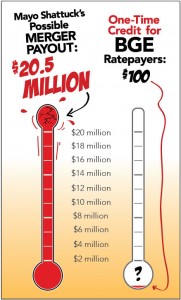
BGE is offering customers a measly $100 credit — a drop in the bucket to residents paying hundreds of dollars a year — while CEO Mayo Shattuck III could receive up to a $20.5 million payout if the merger goes through.

BGE/Constellation also promises there will be no merger related layoffs for two years, but what happens after that?  We feel the potential merger will have a serious negative impact on Baltimore’s local community and economy.  Any merger deal needs to include real rate relief, permanent protection from merger related layoffs, and provisions for job creation.

At the press conference, held in front of the Schaefer Building in downtown Baltimore, speakers from around the city discussed high energy bills, broken promises, and the financial hardship associated with being a BGE customer. Powerful stories indeed.

Did you like this? Share it:

PSC should be skeptical of Constellation-Exelon merger

As feature in the Baltimore Sun, June 27, 2011

http://www.baltimoresun.com/news/opinion/oped/bs-ed-constellation-20110627,0,949814.story

If you drove around many Baltimore neighborhoods during the recent heat wave, you saw the people out on their porches. It’s not because we have no air conditioning. It’s because we can’t afford to turn it on.

All across Baltimore, crippling energy bills have become a fact of life. Over the last decade, Baltimore Gas & Electric (BGE) raised our electric rates 104 percent — the highest rate hike of any major utility in America.

I hope Maryland regulators keep that fact firmly in mind as they begin hearings Tuesday on the proposed merger between BGE’s parent company, Constellation Energy, and the Exelon Corp. of Chicago.

Constellation executives have promised that the merger with out-of-state Exelon will be a good thing for Maryland. But back in 1999, when utility executives were pushing energy deregulation in our state, they also promised it would be good for us. Instead, after deregulation passed, we’ve seen Maryland saddled with some of the highest energy costs in the country.

We need to look more skeptically at the energy executives’ promises this time around. There are major problems with this merger that Maryland’s Public Service Commission (PSC) needs to fix:

  • BGE customers are promised a one-time, $100 credit if the merger goes through, but that doesn’t begin to make up for our highest-in-the-nation rate hikes. BGE ratepayers deserve real and permanent relief from the sky-high bills we’ve been paying.
  • While this deal offers very little to consumers, it could prove incredibly lucrative for Constellation CEO Mayo A. Shattuck III, who could walk away from the merged company with a $20.5 million payout.
  • When first announcing the merger, Constellation and Exelon promised to give $10 million annually to local charities over the next 10 years. But they cut that to just $7 million in their merger application with the PSC. If they’re reneging on promises before the merger is even approved, what can we expect if they seal the deal?
  • The companies have made a “no-layoff” pledge. But that no-layoff promise applies only to BGE, not Constellation, and only for two years. How do we know that thousands of good Baltimore jobs at Constellation won’t be lost? And what will happen at BGE after that two-year window closes?

At the moment, Constellation executives are trying to alleviate concerns about the merger by noting that BGE rates have, for the first time in years, been easing a bit. But remember that back in 1999, deregulation was sold by putting a temporary cap on rates. Once that cap was lifted, rates jumped through the roof.

I fear the Constellation-Exelon merger is the latest in a long string of corporate deals that enrich top executives but leave Baltimore residents even worse off. Constellation is Baltimore’s last Fortune 500 Company, and this merger would move the combined company’s headquarters to Chicago. How can that be a good thing for our city?

Baltimore is already hurting. Twenty-one percent of city residents are unemployed or unable to find full-time work, the highest rate among big East Coast cities. How will we solve our unemployment crisis if thousands of good jobs are lost or shifted to Chicago?

Fortunately, Baltimore residents don’t have to sit idly by and let this merger proceed. Despite deregulation, the PSC still has the power to block this merger — and we as citizens have the right to be part of the process. Good Jobs Better Baltimore, the community-labor coalition I belong to, has petitioned to be a party to the merger hearings. And we’re advocating a different energy future for Baltimore.

Constellation and Exelon have made noises about creating new green-energy jobs. But we need a rock-solid commitment that those new jobs will be created in the immediate future. And that Constellation jobs won’t be shipped off to Chicago in the meantime.

We believe Baltimore residents should be served by a locally controlled utility that provides affordable, reliable energy for customers — not by a distant corporation that generates windfall profits for executives. Baltimore deserves better than the deal that Constellation and Exelon are selling. We shouldn’t be forced to flee from sweltering homes anymore.

Byron Beckford, a BGE customer who lives in Northwood is an activist with Good Jobs Better Baltimore, a coalition of community organizations, unions and religious groups. His email is[email protected].

Did you like this? Share it:
Follow any comments here with the RSS feed for this post.

Good Jobs “Flashmob” Shakes up Shareholders Meeting

Our flashmob of 100 “Electric Slide” dancers shook up the shareholders meeting of Baltimore’s Constellation Energy last Friday.

The Good Jobs Better Baltimore activists descended on the downtown headquarters of Constellation, which owns Baltimore Gas & Electric (BGE), to protest a proposed merger with a Chicago-based company that could ship thousands of good jobs out of our city.

Our coalition’s activist/dancers turned the staid stockholders meeting into something special when they rolled up outside Constellation’s offices in two schoolbuses and poured out onto the sidewalk.

Soon, our every move was being covered by camera crews from WBAL and Fox 45 as well as a reporter from the Baltimore Sun. And our Good Jobs Better Baltimore activists did more than dance.

Inside the shareholders meeting, two of our activists, Byron Beckford and Monica Jones, had proxy votes, so they were able to weigh in on a shareholders resolution opposing the compensation package of Constellation CEO Mayo A. Shattuck III, who garnered $15.7 million in 2010.

Jones spoke at the shareholders meeting in opposition to Shattuck’s supersized pay. “I explained to him, the CEO, how we’re terrified to open our BGE bills,” Jones said. BGE has raised its electric rates faster than any other big U.S. utility over the last ten years.

“I asked him how he could justify that,” Jones continued, “and he didn’t have an answer. He was flustered.”

In a rare rebuke to a CEO, the resolution passed. The company’s shareholders agreed with Jones, who was quoted in the Baltimore Sun saying Shattuck “makes too much.” Though it’s a non-binding resolution, the vote is a major blow to Shattuck’s leadership at a time when he’s trying to push through Constellation’s merger with Chicago-based Exelon Corporation.

That merger would move the combined company’s headquarters to Chicago, threatening the loss of thousands of good jobs in Baltimore. If the deal goes through, Shattuck could also walk away from the company with a $20.5 million incentive package.

This is exactly the kind of corporate wheeling and dealing we’re working to stop in Good Jobs Better Baltimore. While some want to blame our economy’s troubles on teachers and public employees, we’re showing how CEOs like Shattuck and the super-rich have amassed so much wealth that they’ve restricted economic opportunity for the rest of us.

And because they’ve accumulated so much wealth, they’ve gained unprecedented power as well, making it harder and harder for ordinary Americans to have a say in America’s political and economic life.

Good Jobs Better Baltimore is working to call attention to the crisis with creative actions like the Electric Slide — actions that make abstract ideas about the economy relevant to working people struggling to get by.

All too often, people feel like there’s no way to stop bad deals like the Constellation-Exelon merger. But the Good Jobs Better Baltimore dancers are proving we don’t have to let corporate greed slide anymore.

Did you like this? Share it:
Follow any comments here with the RSS feed for this post.

Taking on Maryland’s Millionaires

Good Jobs Better Baltimore members traveled to Annapolis in late March and paid a special visit to the Maryland Chamber of Commerce.

The Chamber, Maryland’s big business lobby, has been pressing an all-too-familiar agenda in the state capital: tax breaks for corporations and the rich, healthcare and education cuts for everyone else.

The Good Jobs contingent — which included more than a hundred activists from the citizens group Progressive Maryland and the unions 1199SEIU, and SEIU Local 32BJ — filled the sidewalk in front of the Chamber.

We protested the Chamber’s efforts to attack funding for vital public services through its opposition to two bills:

  • The Millionaire’s Tax – By blocking S.B. 798, they can snag up to $100 million a year in tax breaks for the rich.
  • Combined Reporting for Corporations – By stopping S.B. 305, big business can keep evading up to $170 million a year in state taxes.

When a real live Fat Cat showed up during the action, two of our “Citizens Police” put the cuffs on him and carted him away for his brazen tax evasion.

Unfortunately, the Maryland legislature proved less aggressive than our Citizens Police. They ended the session without passing those bills, so it’s a fight we’ll have to continue next year.

Did you like this? Share it:
Follow any comments here with the RSS feed for this post.